The Importance of Sleep for Humans and Dogs
 Jules Ballard
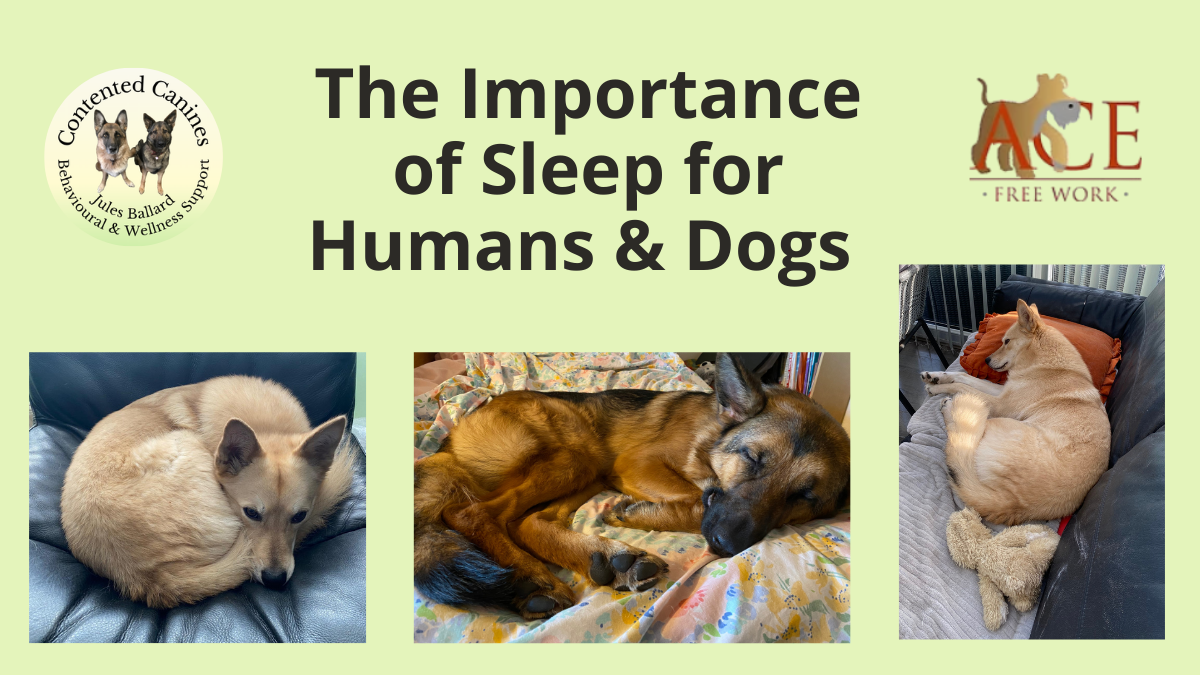
The Quiet Wisdom of Sleep
There’s something deeply peaceful about watching a sleeping dog. Perhaps they’re curled into a soft spiral on the sofa, paws twitching gently as dreams drift through their mind. Maybe their ears flick, their nose wiggles, or they let out the tiniest sigh as their body sinks deeper into rest. In those quiet moments, everything seems slower and calmer.
Yet how often do we truly think about what sleep means for them or for ourselves?
In our busy human lives, sleep is often treated as something negotiable. We stay up a little later, scroll a little longer, push through tiredness with coffee or determination. But it all adds up and when sleep is lacking, the effects can show up in our mood, patience, health and ability to cope with the world around us.
Dogs, of course, live by slightly different rhythms. They nap, stretch, wander, then nap again, moving naturally between activity and rest throughout the day. Yet just like us, their sleep is not simply ‘switching off’, it is a vital biological process that supports memory, emotional balance, learning and physical repair.
Sleep: Why It Matters for Both Humans and Dogs
Sleep is one of the most fundamental pillars of health, yet it is often the first thing we sacrifice in busy modern life. Around 35% of humans experience insomnia, and poor sleep has far-reaching consequences. When sleep is disrupted or insufficient it can impact both physical and mental wellbeing, contributing to increased stress, reduced performance and focus, greater susceptibility to illness, and worsening of existing health conditions and pain.
Good quality sleep is not simply about time spent in bed. There are three key elements that determine whether sleep is truly restorative:
- Enough total hours so that you feel rested and alert the following day
- Minimal interruptions, allowing the brain and body to complete several full sleep cycles
- Adequate deep sleep, which supports physical repair and restoration
When these elements are missing, the effects ripple through many areas of health.
Sleep and Emotional Regulation
Research increasingly shows how strongly sleep affects emotional regulation. A recent review found that 81% of studies reported an association between poor sleep quality and increased aggression (van Veen, 2021). Most of us can relate to this in a very human way: when we are tired, our emotions can run closer to the surface, we are more irritable with less patience, our emotional responses are stronger, and our ability to cope with challenges and stress decreases.
Our Dogs Need Good Sleep Too
This naturally raises an interesting question for those of us who live with dogs. If poor sleep affects human emotional regulation and behaviour, could the same be true for our canine companions?
Dogs rely on sleep just as much as we do for emotional balance, learning, memory, and physical recovery. If a dog is not getting enough good quality sleep, it is reasonable to consider that their reactivity or sensitivity to triggers may increase, simply because their nervous system has not had adequate time to restore itself.
Sleep differences between Dogs and Humans
Adult humans typically need 7–9 hours of sleep, usually taken in one continuous period at night of 4-5 sleep-wake cycles with each sleep cycle lasting about 90 minutes (Bódizs, 2020). This pattern is known as monophasic sleep.
Adult dogs generally need 12–14 hours of sleep in a 24-hour period and puppies need 18–20 hours as their brains and bodies are rapidly developing. Rather than sleeping in one long stretch, they cycle between sleep and wakefulness, taking multiple naps during the day, with longer periods of sleep in the afternoon and overnight. A dog’s sleep-wake cycle is much shorter lasting about 20 mins. They often join three or four of these cycles together before waking or shifting position.
A sleep-wake cycle is split into Non-Rapid Eye Movement (NREM) sleep and Rapid Eye Movement (REM) sleep. Humans have about 75% NREM sleep of which about 13-25% is deep sleep (slow-wave sleep). Deep sleep helps with physical healing and repair, growth, hormonal and immune system regulation and energy replenishment, while REM sleep is important for cognitive functions; learning, memory, creativity, problems solving and emotional regulation. REM sleep (20-25%) is when we dream vividly, processing emotions and experiences. Dreaming also occurs in deep sleep, but the dreams are rarely remembered. Individuals with depression have greater percentages of REM sleep which is why they often feel tired.
We have more deep sleep in the earlier part of the night and more REM sleep towards the morning, which is why we tend to remember our dreams more when we wake in the morning.
A dog’s sleep cycle is approximately 65% NREM and 35% REM sleep
Dogs Are Social Sleepers
Dogs evolved as social animals, and this extends to sleep. Many dogs prefer to sleep near their people or other animals, as proximity helps them feel safe. Given the choice, dogs often choose slightly elevated sleeping places, such as sofas, beds, or raised dog beds, where they can observe their surroundings. Feeling safe is essential for restful sleep. Allowing dogs some choice about where they sleep can support this sense of security. It is fine for your dogs to sleep with you if they choose to and if they don’t disturb you. Some dogs curl up and don’t move until morning, whilst others fidget all night. This is not conducive to your sleep cycle, which is just as important.
69b4549d78883_lg.png)
As tempting as it is…. when they look irresistibly cute…. try not to disturb dogs when they are sleeping. Touching or waking them repeatedly can interrupt sleep cycles and reduce the restorative benefits.
What Happens When Sleep Is Poor?
When sleep quantity or quality decreases, the effects can be surprisingly wide-ranging. Research links poor sleep with:
- Reduced memory consolidation
- Reduced ability to regulate body temperature, so feeling cold
- Altered glucose regulation, often increasing hunger
- Changes in metabolic rate, leading to weight gain
- Reduced immune function, leading to reduced ability to fight off infections
- Decreased cognitive capacity
- Stronger emotional responses, including irritability and anger
Many of these effects are believed to occur in dogs as well, particularly in relation to learning, behaviour, and emotional resilience.
Supporting Better Sleep Holistically for Humans and Dogs
Both humans and dogs benefit from approaches that gently support the parasympathetic nervous system, often referred to as the ‘rest and digest’ state. The good news is that there are many simple ways to support healthier sleep patterns for both species.
For Humans
- Maintain a consistent sleep schedule, going to bed and waking at similar times each day
- Reduce screen exposure in the evening, as blue light can suppress melatonin production
- Dimming lights in the evening or using a green light
- Having a warm bath or shower
- Create a calm bedtime routine to signal to the body that it is time to rest
- Ensure the bedroom environment is cool, dark, and quiet
- Avoid heavy meals, caffeine, or alcohol close to bedtime
- Gentle evening rituals such as reading, stretching, yoga, relaxation and breathing techniques
For Dogs
- Provide a safe, comfortable sleeping space where your dog can rest undisturbed
- Allow them to choose their preferred sleeping location where possible, some dogs may like a den-like area, whilst others prefer a large space to stretch out
- Ensure they have appropriate mental and physical enrichment during the day so that sleep comes naturally
- Be aware of the effects of over-exercise and over-stimulation which can increase arousal and cortisol levels
- Swapping some walks for ACE Free Work and other walk alternatives
- Don’t do vigorous exercise just before bed
- Avoid repeatedly waking them during naps
- Support a predictable daily routine, which helps regulate their internal rhythms
For dogs who are easily disturbed or reactive, ensuring they get adequate uninterrupted sleep can sometimes make a noticeable difference in their ability to cope with daily life.
Botanical Support
Gentle aromatics can also help support relaxation and sleep when used thoughtfully. Ensure you have checked that there are no contraindications for either you or your animal prior to use. See https://contented-canines.newzenler.com/courses/botanical-basics
Always offer any essential oils or hydrosols to your animal by self-selection. Animals are far more sensitive to scent than we are, so they should always be able to move away from the aroma if they wish. Inhaling Lavender, Chamomile, Frankincense, Melissa, Valerian and Vetiver diluted essential oils or hydrosols
Certain herbs have traditionally been used to support rest and relaxation in both humans and animals: Ashwaghanda, Chamomile, Elderberry, Hibiscus, Hops, Melissa, Passionflower and Valerian root
A Final Thought - A Shared Need for Rest
Perhaps one of the simplest gifts we can offer both ourselves and our companion animals is the space for true rest, calm evenings, predictable rhythms, and the permission to slow down when the body asks for it. And maybe our dogs already know this. After all, they seem to have mastered the art of curling up, letting go, and trusting that the world can wait until morning.
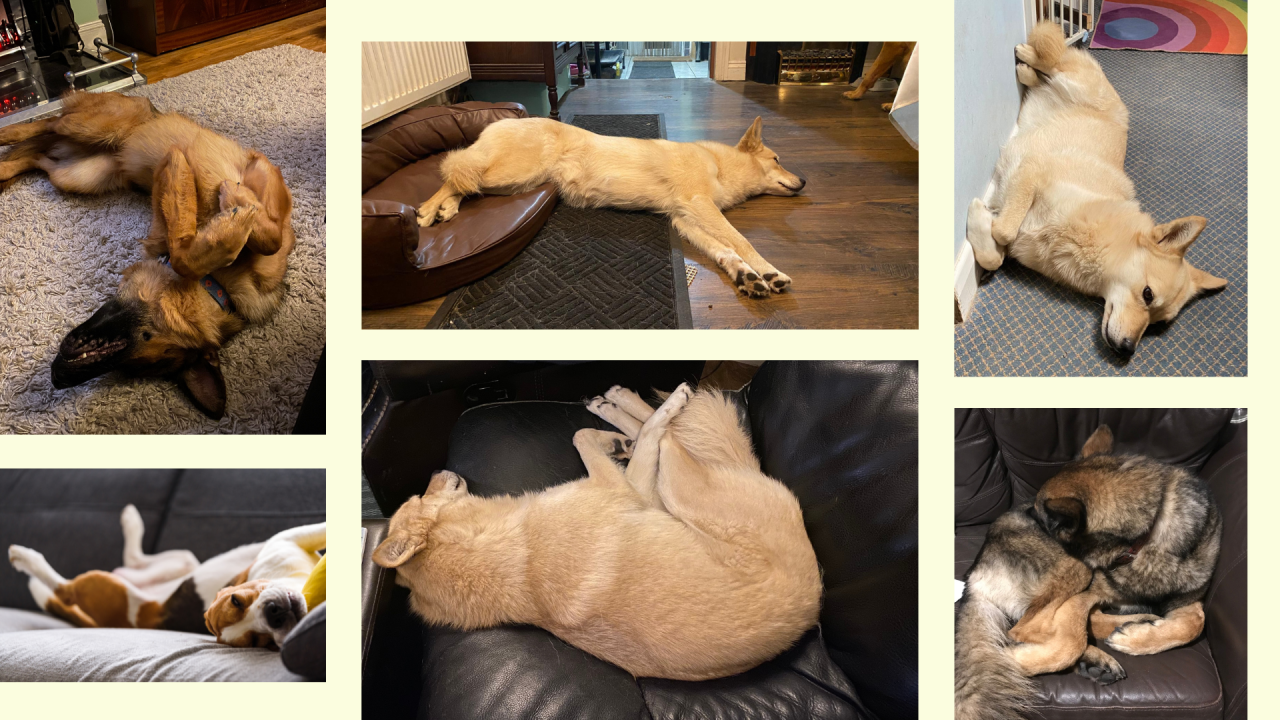
Dogs have some great sleeping positions which would be incredibly uncomfortable for us
Jules Ballard - Author of Holistic Help For Your Anxious Dog https://www.amazon.co.uk/Holistic-Help-Your-Anxious-Dog/dp/B0H6BX4M7N/
Holistic Haven Circle Membership - Wellness for people and Paws - A community for ongoing holistic support, learning and connection https://holistichaven.newzenle...