The Hidden Risks of Ball Throwing for Dogs (and Safer Ways to Play)
 Jules Ballard
Understanding why repetitive ball throwing can contribute to soft tissue injuries, joint wear and tear and over-arousal
The Hidden Risks of Ball Throwing for Dogs (And Safer Ways to Play)
For many dogs, few things in life are as exciting as chasing a ball or frisbee. The moment they see it in your hand, their eyes light up, their body quivers with anticipation, and suddenly you’re the most important person in the world.
So hearing that ball throwing may increase the risk of pain, injury, or arthritis can be difficult for many guardians to accept. After all, our dogs love it. It can feel mean, even unfair, to take away something that brings them so much joy.
But understanding why repetitive ball throwing can be problematic allows us to make kinder, more informed choices for our dogs’ long-term health. And the good news is that there are plenty of safer, enriching alternatives that dogs enjoy just as much.
How Dogs Move: The Front vs Back End
To understand why ball throwing can be physically challenging for dogs, it helps to look at how their bodies are designed to move.
When a dog runs forward, the back legs provide the engine, driving the body forward. The front legs act as the brakes and shock absorbers.
However, dogs actually carry around 60% of their body weight through their front limbs, with only 40% through the hind limbs. This means the front end is already working harder, even before we add in high-impact activities.
The Unique Structure of the Canine Shoulder
Dogs’ shoulders are also very different from ours.
Unlike humans, dogs do not have a clavicle (collarbone). This means the shoulder has no direct bony attachment to the skeleton. Instead, the front limb is suspended by a group of muscles known as the thoracic sling.
These muscles include:
-
Latissimus dorsi
-
Trapezius
-
Deep pectoral
-
Superficial pectoral
-
Brachiocephalicus
-
Omotransversarius
-
Rhomboid
-
Serratus ventralis (a deep stabilising muscle)
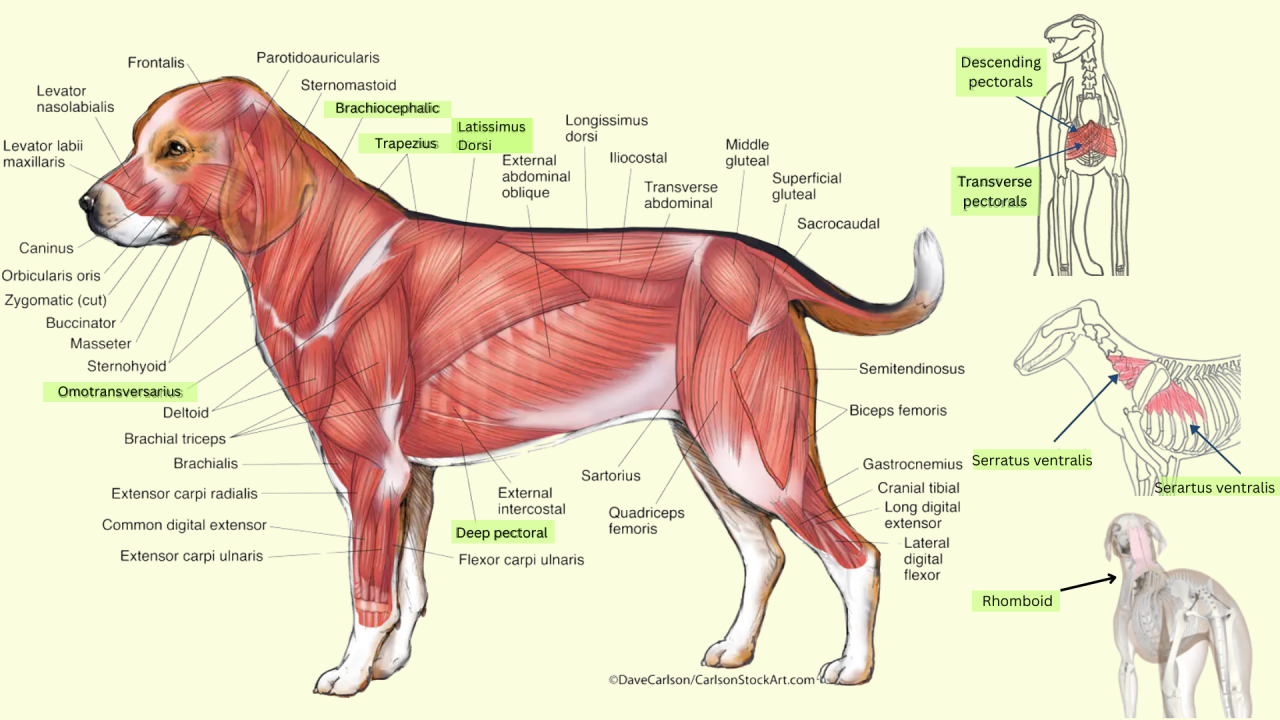
While this design allows dogs to move efficiently and run long distances with minimal resistance, an important survival advantage, it also means the shoulders rely heavily on muscular support and stability.
What Happens During Ball Throwing
Ball chasing often involves:
-
explosive acceleration
-
sudden stops
-
tight turns
-
jumping
-
sliding to brake
These movements dramatically increase the forces travelling through the front limbs, which are already carrying most of the dog’s body weight.
Over time, this can cause tiny micro-tears in muscles and cartilage, contributing to increased wear and tear in the joint and raising the risk of pain, soft-tissue injuries, and arthritis.
The superficial muscles, particularly the pectoral muscles, are most commonly affected.
If a dog already has weakness or discomfort in the hind end — for example from:
-
arthritis
-
hip dysplasia
-
luxating patella
-
other orthopaedic conditions
— they may shift even more weight onto their front limbs, placing additional strain on the shoulder muscles.
The serratus ventralis, a deep stabilising muscle, is less commonly injured because of its depth. However, studies of sled dogs have shown strain in this muscle when dogs frequently travel at speed downhill, where braking forces are increased.
The Behavioural Side of Ball Obsession
There’s also a behavioural component to consider.
Ball chasing is an extremely arousing activity. It increases levels of adrenaline and cortisol, which can push dogs into a heightened state of excitement.
For some dogs, repeated high-arousal games can contribute to:
-
trigger stacking (too many 'candles' already lit that day)
-
difficulty settling afterwards
-
increased reactivity
-
frustration
-
obsessive behaviours around the ball
-
resource guarding
Some dogs become so focused on the ball that the world disappears, which may look like enthusiasm, but can actually be a sign of an adrenaline-fuelled feedback loop.
If You Love Playing Ball… Don’t Panic
Before guilt creeps in, take a breath.
Most of us have thrown a ball for our dogs countless times. It’s a common way to exercise them, and many of us were never told there might be risks involved.
Those hopeful eyes and wagging tail can make it very difficult to say no!
The aim isn’t perfection or removing joy from your dog’s life. Instead, it’s about reducing risk where possible and creating healthier ways to play.
Safer Ways to Play Ball
If you’d prefer not to remove ball games entirely, there are some simple ways to make them safer.
Warm up first
Just like humans, dogs benefit from warming up before intense exercise and cooling down afterwards.
Reduce the number of throws
Repetitive chasing is where most of the strain occurs, so fewer repetitions can make a big difference.
Keep the ball low and slow
Avoid throwing the ball high in the air where your dog has to leap.
When dogs jump, around 4.5 times their body weight travels through their front limbs — about 90 kg of force for a 20 kg dog.
Roll the ball instead of throwing it
Rolling the ball along the ground encourages a slower chase and reduces jumping and sudden braking.
Avoid daily ball games
Mixing activities helps reduce repetitive strain.
Choose safe surfaces
Avoid unstable or slippery surfaces such as:
-
sand
-
gravel
-
ice
-
wet grass
-
laminate flooring
-
downhill slopes
Skip the ball launcher
Ball launchers can increase the distance thrown by three times, encouraging faster, more intense chasing.
Don’t play if your dog is injured
Even minor strains need time to heal properly.
Try hiding the ball
Games like 'find it' engage your dog’s brain and nose while reducing high-impact movement.
Wonderful Alternatives to Ball Throwing
Many dogs thrive when we replace repetitive chasing with more mentally enriching activities, such as:
-
Scent work
-
ACE Free Work
-
Enrichment games
-
Swimming
-
Foraging activities
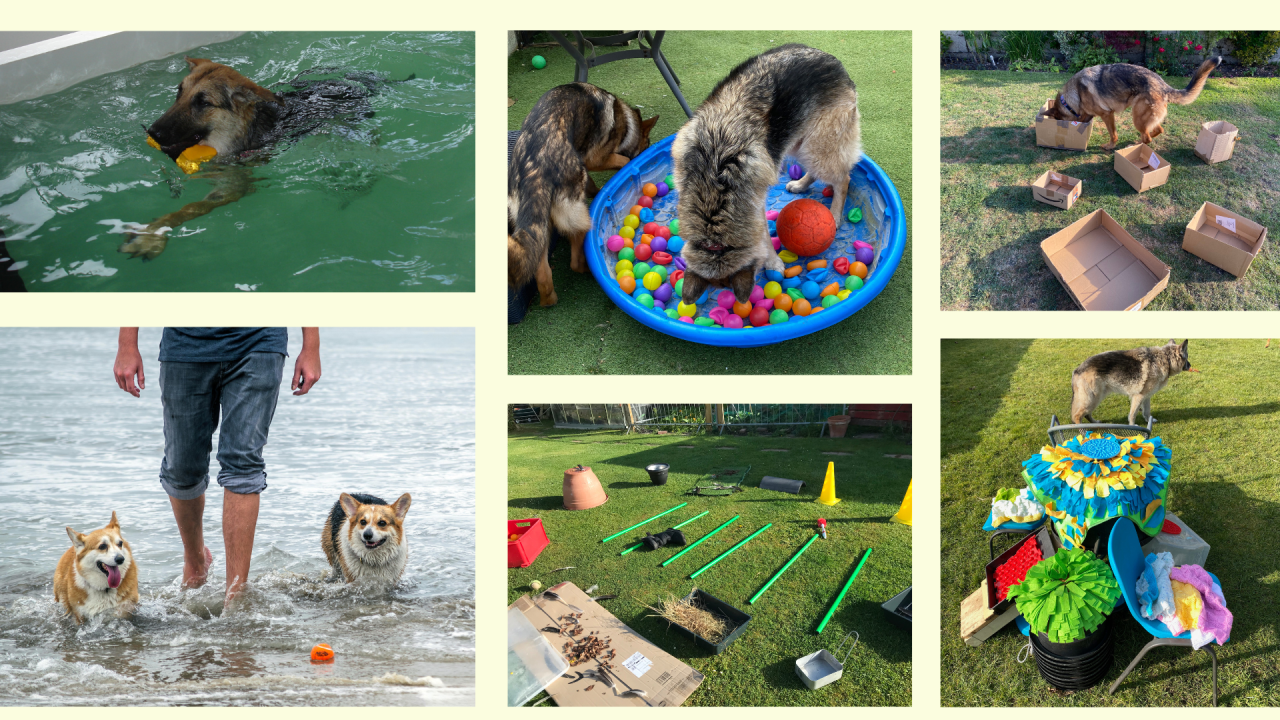
Depending on the breed, many dogs, particularly gundogs, are perfectly happy simply carrying a ball or toy in their mouth without it needing to be thrown repeatedly.
A Final Thought
Dogs don’t actually care whether they chase a ball or sniff through a patch of grass searching for hidden treats. What they care about most is sharing an experience with you.
By understanding how their bodies work and adjusting how we play, we can help protect their joints, reduce injury risk, and keep them happy, healthy, and active for many years to come.
If you'd like more ideas for safe and enriching activities, you might enjoy exploring my Enrichment Course, where I share simple ways to support your dog’s physical and emotional wellbeing.
https://contented-canines.newz...
Jules Ballard - Author of Holistic Help For Your Anxious Dog https://www.amazon.co.uk/Holistic-Help-Your-Anxious-Dog/dp/B0H6BX4M7N/
Holistic Haven Circle Membership - Wellness for people and Paws - A community for ongoing holistic support, learning and connection https://holistichaven.newzenle...
Categories: : Behaviour